There is a chapter in Flatline called Shakti. It happens in the small hours, in the dark, and most of it is Sofie trying to understand what her own body is doing. Somewhere in the middle of it she remembers a temple.
Sofie was ten. Her grandmother took her to see a goddess and told her who that was. That one word was the whole lesson, and Sofie carried it for the rest of her childhood next to a second lesson that said the opposite. This page is about both of them, and about what the old books actually say, because the grandmother was not making it up and I did not want to either.
A sneak peek. Flatline is not out yet, so you are reading this before the book is. The page quotes one passage from it, and that passage gives away nothing about the plot.
Bhavana B
Not a retelling of the gods. Sofie is not Durga and Jimmy is not Shiva. This page is about what a girl was taught, from two directions, and what it did to her. The old texts are here because they are real and because I checked every line of them.
Why this page exists
I am writing this for two reasons, and I would rather say them than have you guess.
The first is the songs. Some of them are about the morning after a night when a woman took exactly what she wanted and then felt shy about it. The man in them is amazed by her, and proud of her, and cannot find words for what he feels, and he will not let her carry any shame. They are about the morning more than the night, and I wanted the reason behind them said out loud.
The second is Sofie. The book gives her two lessons, one from her family and one from the temple, and the songs are where the temple wins. I did not want that to be only my say so, so I had every source behind it checked line by line, and I have written down only what I can stand behind.
Shakti is the word her grandmother used. This page is what I found underneath it.
The passage
Here is the part of Chapter Twenty One this page grows out of. First the lesson she was given by her family, and then the one she was given at the temple.
FROM FLATLINE, CHAPTER TWENTY ONE · SOFIE REMEMBERS
Because she had been told the opposite her entire life.
Too tall. Too big. Too much of everything. Stand at the back for the photograph. Don't wear that. Don't stand so straight. Her aunts' hands on her shoulders in a doorway, pressing down, as if the problem could be folded away. A grandmother who had looked her over at fifteen and sighed and said it would be hard to find a boy.
And underneath all of that, in the same house, in the same language, the older thing nobody wanted to look at directly.
SOFIE REMEMBERS, CONTINUED
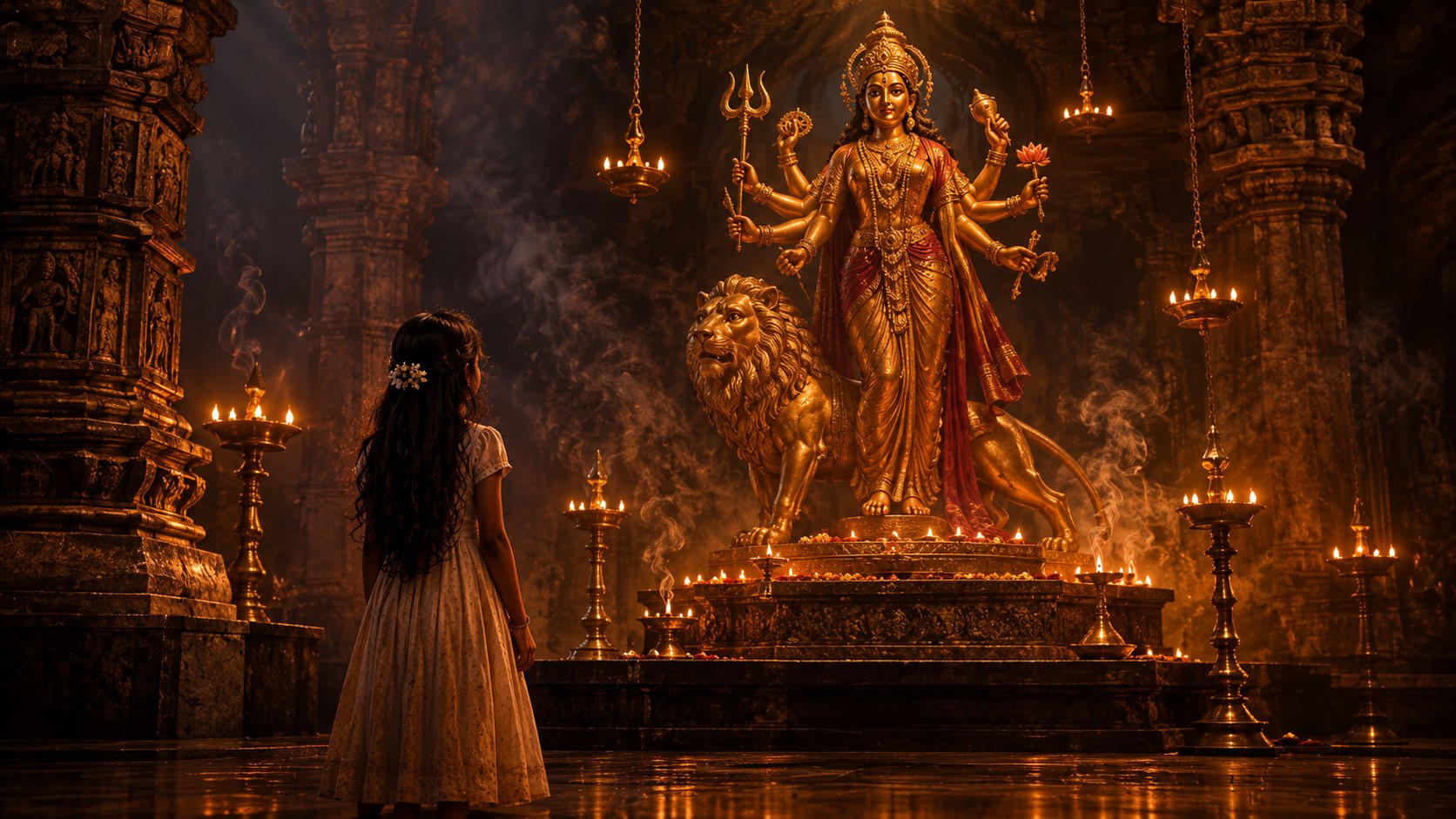
Because her grandmother had also taken her, at ten years old, to a temple where the goddess stood with eight arms and a lion under her and the whole universe in her hands, and told her who that was.
Shakti.
Not a man's helper. Not his softness. His power. The old books were not shy about it, whatever her aunts pretended. Without her he is a corpse on the ground. She is not what he protects; she is what moves him, what makes him anything at all, and the force of her is the point of her and always had been.
SOFIE REMEMBERS, CONTINUED
There was a line of it in the old manuals too, the ones nobody in her family would ever have admitted to owning. That the finest union is the matched one. Equal to equal, force meeting equal force. That a mismatch is the only real misfortune, and that a woman who can take the whole of a man and give back the whole of herself is rare, and is worth a lifetime, and that a man who finds one should understand what has happened to him.
She had been taught both of those things in one childhood.
You are a goddess.
Stand at the back; you are too big for the photograph.
That is two claims about the old world, tucked inside a scene about a woman remembering what it was like to be wanted for everything she had spent years apologizing for. A goddess with eight arms and a lion. And a saying that without her he is a corpse. Each one has a source. Below, each one is taken apart and put next to what the source really says, including the places where the book and the source part ways.
Things this page will not pretend about
- The saying about the corpse is a saying. "Shiva without Shakti is shava" is repeated everywhere, and it is not a quotation from a verse I could point you to. One article ties it to the Kularnava Tantra, and I could not confirm that, so it stays a saying here. The first verse of the Saundarya Lahari, below, says the same thing in a form I can stand behind.
- Who wrote the Saundarya Lahari is not settled. Tradition gives it to Adi Shankara. Other accounts give it, or part of it, to a poet called Pushpadanta. This page quotes the first verse and says nothing about the author that the sources do not.
- Kumarasambhavam is a poem, not a rule book. Canto Eight shows how a great poet treated the subject and how readers argued about it. It does not command anything, and this page does not say it does.
The goddess with eight arms
The book never names the goddess in the temple. It gives her eight arms, a lion beneath her and the universe in her hands, and then it gives her the one word.
The picture is the way Durga is most often shown. According to Britannica, Durga is a principal form of the Goddess, also known as Devi and Shakti, usually depicted riding a lion, with eight or ten arms, each arm holding the special weapon of one of the gods. The gods gave her those weapons for her battle against the buffalo demon, and the same article describes her as embodying their collective energy, which in Sanskrit is the word shakti.
So the word the grandmother says is more than a name. Shakti means power, energy, the force that does the work. In that story the gods hand her their weapons and their strength, and she is the one who goes out and fights the demon.
Mine the universe in her hands
The universe in her hands is the book's image. I am not claiming it as a standard detail of the iconography, and Britannica does not mention it. The arms, the lion and the word Shakti are the parts that rest on the sources.
The first verse of the Saundarya Lahari
The old books say it too. The clearest place is the opening verse of the Saundarya Lahari, a hymn of about a hundred verses to the Goddess, traditionally attributed to Adi Shankara. Its first verse is the one the grandmother's line comes from in spirit, and it is much blunter than the saying.
The text Saundarya Lahari, verse 1
शिवः शक्त्या युक्तो यदि भवति शक्तः प्रभवितुं
न चेदेवं देवो न खलु कुशलः स्पन्दितुमपि ।
अतस्त्वामाराध्यां हरिहरविरिञ्चादिभिरपि
प्रणन्तुं स्तोतुं वा कथमकृतपुण्यः प्रभवति ॥ १ ॥
śivaḥ śaktyā yukto yadi bhavati śaktaḥ prabhavituṃ
na cedevaṃ devo na khalu kuśalaḥ spanditumapi
atastvāmārādhyāṃ hariharaviriñcādibhirapi
praṇantuṃ stotuṃ vā kathamakṛtapuṇyaḥ prabhavati
If Shiva is united with Shakti, he is able to create. If not, the god cannot so much as stir. Therefore, how can one who has not earned merit have the power to bow to you or praise you, you who are worshipped even by Hari, Hara and Viriñci?
Hari is Vishnu, Hara is Shiva and Viriñci is Brahma, so the verse names all three of the great gods and says that even they bow to her. The first half is the part that matters here. It does not say she helps him. It says he is able to create only when he is joined with her, and otherwise he cannot even move.
| śivaḥ | Shiva |
| śaktyā yuktaḥ | united with Shakti |
| yadi bhavati | if he is |
| śaktaḥ prabhavitum | able to create |
| na ced evaṃ | if not so |
| devaḥ | the god |
| na khalu kuśalaḥ spanditum api | is certainly not capable even of stirring |
| ataḥ tvām ārādhyām | therefore you, who are to be worshipped |
| hari hara viriñci ādibhiḥ api | even by Hari, Hara, Viriñci and the others |
| praṇantuṃ stotuṃ vā | to bow to or to praise |
| katham akṛtapuṇyaḥ prabhavati | how is one who has not earned merit able |
The idea why the verse matters here
Wikipedia's summary of the hymn describes it as presenting the Supreme Reality as non dual but with a distinction between Shiva and Shakti, in which Shakti is the dominant factor and Shiva the substratum. That is the same claim the grandmother makes with one word. Not his helper. His power.
Without her he is a corpse
The book's line is "Without her he is a corpse on the ground." That one comes from a different image, and it is worth keeping it separate from the temple goddess, because it is not Durga's.
It belongs to Kali. In her four armed and ten headed forms Kali is shown standing on the prone, inert body of Shiva. The common reading, as Wikipedia puts it, is that she represents Shakti, the power of creation, while he represents consciousness. The saying built on that picture is "Shiva without Shakti is shava." Shava is the Sanskrit word for corpse.
There is a second reading and the same article gives it. Some interpret the picture the other way round: that Mahakali's destructive fury can only be calmed by Shiva's presence, which keeps nature from being completely overrun. She is the force, and he is what holds it from burning the world. The book does not take this reading, and a page that only gave the first would be giving you half.
The wordplay shiva and shava
The same article notes that the saying works as a pun. In Sanskrit script every consonant carries an inherent short a, and adding the short i vowel turns shava into shiva. That small i is described as the female power that activates creation. Take it away and the god is a corpse. Put it back and he is Shiva.
Two lessons in one childhood
Put side by side, the sources do not agree with the aunts at all. The goddess is the biggest thing in the room. She is armed, she is on a lion, she is made out of the strength of every god at once. The great hymn says the god cannot move without her. Everything Sofie was told to fold away, the temple had already put on show.
And the family said both. That is the part I wanted to write. It was not a household that had forgotten the old things. It was a household that kept the goddess in the temple and kept the girl at the back of the photograph, and saw nothing strange in that. The grandmother who sighed at fifteen is the same grandmother who took her to the temple at ten. The book does not explain that, and I will not either. It lets the two lessons sit in one house.
What happens next in the chapter is what it is for. A boy in a lecture hall looked at everything she had been apologizing for and wanted all of it, and years later the memory of that goes through her whole body at once. Nobody has to tell her which of the two lessons is true. Her body answers, and it answers for the temple.
One of the four aims of a life
There is an older frame around all of this, and it is worth knowing before you hear the songs.
The tradition names four aims of a human life. Dharma, what is right. Artha, what you build. Kama, desire. Moksha, release. Kama is glossed as pleasure, love, the enjoyment of the senses, affection. It sits in the middle of that list, not outside it, and the four together are described as the goals a person needs for a full and happy life.
Read that again, because it is the whole argument. Desire was not something to be endured in private and left out of the account. It was one of the four things a life was understood to be for. Each of the four has a literature of its own.
That is the ground a poet was standing on when he gave a canto to it. The objections to that canto came from readers, later.
One Telugu song on the soundtrack sits inside that frame without ever naming it. It has desire at one end of a sentence and release at the other.
The whole song is one long drinking of someone's beauty. Two lines in the middle reach for the largest words in the tradition.
| Nee gontulo palikina okka maata chaalu | One word spoken in your voice is enough |
| E vedamoo chadavadakunda naaku moksham dorikipotundi | Without reading a single Veda, moksha would come to me |
| Ninnu devata ani pilavanu | I will not call you a goddess |
| Devatalu intha matthuni ivvaru | The gods do not give this much intoxication |
Mine kama and moksha in one breath
In the old list, desire and release are two of the four aims, and they stand at opposite ends of it. In this song one word in her voice does the work of a whole lifetime of study. Desire does not compete with release here. It arrives at the same place faster.
The song is also stubborn about the goddess, the way Tujhe Devi Kahoon Ya Kavita Kahoon is: she is not called one, because the gods never gave anyone this.
The poet who did not look away
If you are going to say the songs are fine, you may as well ask the oldest poet in the language what he thought. Mahakavi Kalidasa, usually called the greatest writer India has produced, gave a whole canto of Kumarasambhavam to the union of Shiva and Parvati. It is the eighth, called Suratavarnanah, the description of lovemaking, and in the text scholars accept as his it is where the poem ends.
It has been argued over for a very long time. Moralists objected, for centuries, on the grounds that a poet should not describe the union of the parents of the universe. Some editions leave the canto out, especially ones printed for students. Others defended it, and one commentator called the hesitation to write about it foolish. The objections came from readers. The poem is still there, and still read.
This is the last verse of the poem.
Mahakavi Kalidasa wrote Canto 8, verse 91, the last verse of the poem
समदिवसनिशीथं सझ्गिनस्तत्र शंभोः
शतमगमदृतूनां साग्रमेका निशेव ।
न तु सुरतसुखेभ्यश्छिन्नतृष्णो बभूव
ज्वलन इव समुद्रान्तर्गतस्तज्जलौघैः ।। ࡗࡕ ।।
samadivasanisitham sanginas tatra shambhoh
shatam agamad ritunam sagram eka niseva
na tu suratasukhebhyash chinnatrishno babhuva
jvalana iva samudrantargatas tajjalaughaih
There, for Shambhu in her embrace, with day and midnight alike, a full hundred seasons passed as a single night. And still his thirst for the joys of love was not cut off, as a fire gone down into the ocean is not put out by its floods.
That is how he chose to end the whole poem: a fire the ocean cannot put out. Sau Mausam Beete is built on this verse, and its line by line translation is on the Kumarasambhavam page.
After the night: songs that say nothing was wrong
There is a kind of song on the soundtrack that is easy to hear only on the surface. It is about a night when a woman took exactly what she wanted, and a morning when she is shy about it. The night is not what the song is about. The morning is.
Go back to the passage. Sofie was told her whole childhood to make herself smaller. The aunts pressed her shoulders down. Nobody ever said the shame out loud, because nobody had to. It was in the doorway, in the photograph, in the way a grandmother sighed. A woman raised like that does not get to the other side of a bold night and feel free. She gets there and feels the old voice come back. Who did that. Was that allowed.
These songs are the man's answer to that voice. He is not surprised that she is bold. He is amazed by it, and proud, and he cannot find words big enough for what he feels. What he will not allow is for her to carry shame for it afterwards. Every line says the same thing in a different way: you wanted it, you took it, you gave it, and there was nothing wrong in any of it. That is what Shakti looks like at dawn. The power does not have to apologize for itself.
The whole song is a man asking a woman to look him in the eye. She is trembling, and he tells her to let herself tremble. She is hiding her smile, and he tells her it is his.
| Chhup mat mujhse | Do not hide from me |
| Dekh mujhe zara | Look at me for a moment |
| Kuch nahi hua galat | Nothing went wrong |
| Kaanp rahi hai tu | You are trembling |
| Kaanpne de khud ko | Let yourself tremble |
| Yeh jo mehsoos ho raha hai | This thing you are feeling |
| Yahi hona chahiye tha | This is exactly what was meant to be |
| Aankhein mila mujhse | Meet my eyes |
| Tu ne kuch galat nahi kiya | You did nothing wrong |
| Kuch galat nahi tha ismein | There was nothing wrong in it |
| Jo tu ne diya aaj mujhe | What you gave me today |
| Woh sahi tha, bilkul sahi tha | That was right, completely right |
| Darr nahi tha tujhe tab | You were not afraid then |
| Ab kyun darr rahi hai | Why are you afraid now |
| Woh tu thi jo aayi thi | It was you who came |
| Woh tu thi jo chahi thi | It was you who wanted |
| Woh tu thi, poori tu thi | That was you, all of you |
| Muskura rahi hai tu | You are smiling |
| Chhupa mat mujhse | Do not hide it from me |
| Woh muskaan meri hai | That smile is mine |
| Yahi tu hai, yahi rehna tu, kuch mat badal | This is you. Stay exactly this. Change nothing. |
| Sahi tha yeh sab, sahi thi tu | All of this was right, and so were you |
The line that carries it
You were not afraid then. Why are you afraid now. It is not a scolding. It is the most gentle thing in the song, because he is pointing at the gap between who she was a minute ago and who the old voice is telling her to be. The first one was real. He saw her. He wants her to see her too.
The song ends on change nothing. Not stay shy and not be bolder. Just what she is, in both rooms.
The Telugu answer is built on a split. At night, her courage. At dawn, her shyness. The song loves both and says they are one person.
| Raathiri nee dhairyam entha andam | How beautiful your courage is at night |
| Vekuva nee siggu entha andam | How beautiful your shyness is at dawn |
| Rendoo nuvve ayithe | And if both are you |
| Ee janma entha dhanyam | How blessed this life is |
| Puvvu thene ivvadam thappu kaade | A flower giving its honey is not wrong |
| Vaana nelanu thaakadam neram kaade | Rain touching the earth is no crime |
| Nuvvu ichchindi naa praananiki velugu | What you gave is light to my life |
| Adigindi adiginatte theesukunna cheyi | The hand that took exactly what it asked for |
| Naa velu thaakagaane entha vanuku | How it trembled the moment my finger touched it |
| Nuvvu daachaalanukunnadi naa gundelo deepamaindi | What you wanted to hide became a lamp in my heart |
| Nuvvu siggu padda kshaname naa kallaku pandagaindi | The moment you were shy became a feast for my eyes |
| Ae thappoo ledu ee udayamlo | There is no wrong in this morning |
| Ae machchaa ledu nee manasulo | There is no stain in your heart |
| Ninna raathiri nuvvu nuvvugaane vachchaavu | Last night you came exactly as yourself |
| Ee udayam kooda alaage undipo | Let this morning stay exactly that way too |
The line that carries it
Last night you came exactly as yourself. Let this morning stay exactly that way too. Most songs about a night like this are about the night. This one is about the morning after, which is where the shame is waiting, and it refuses to let the morning be different from the night.
Mine the claim these songs make
Two songs, two languages, one claim, and it is mine, not a quotation: a woman's wanting is the same as a man's, so she has no more to be ashamed of than he does. I am not citing a text for it. The old frame above is why I believe it belongs in the tradition rather than against it. The songs are where I say it myself.
✦
A last word
The grandmother had one word and the temple had one picture, and neither of them had the whole argument. The hymn has it. The book has a woman in a dark room who finally hears the temple louder than the photograph.
If you are the one who was told to stand at the back, the goddess with eight arms was never standing at the back. Go and look at her.
Where this page gets its facts
The Sanskrit of Saundarya Lahari verse 1, its transliteration and its word meanings come from the Saundarya Lahari text on shlokam.org. The verse's central idea, the authorship note and the description of the hymn come from the Wikipedia article on Saundarya Lahari. The description of Durga, her lion, her eight or ten arms and her weapons comes from Britannica's article on Durga. The four aims of life, their names and the meaning of kama come from the Wikipedia article on Purushartha. Canto 8, verse 91 comes from the Nirnaya Sagar 1955 edition at Sanskrit Wikisource, and the background on the poem and the arguments over the eighth canto comes from the Wikipedia article on Kumarasambhava. The Kali image, the saying about shava, the pun on shiva and shava, and the second reading of the image come from the Wikipedia article on Mahakali.
The passage quoted from Chapter Twenty One is from Flatline. Where the book and a source part ways, the page says so. Where something could not be confirmed, it is called a saying or the novel's own and not given as a quotation.