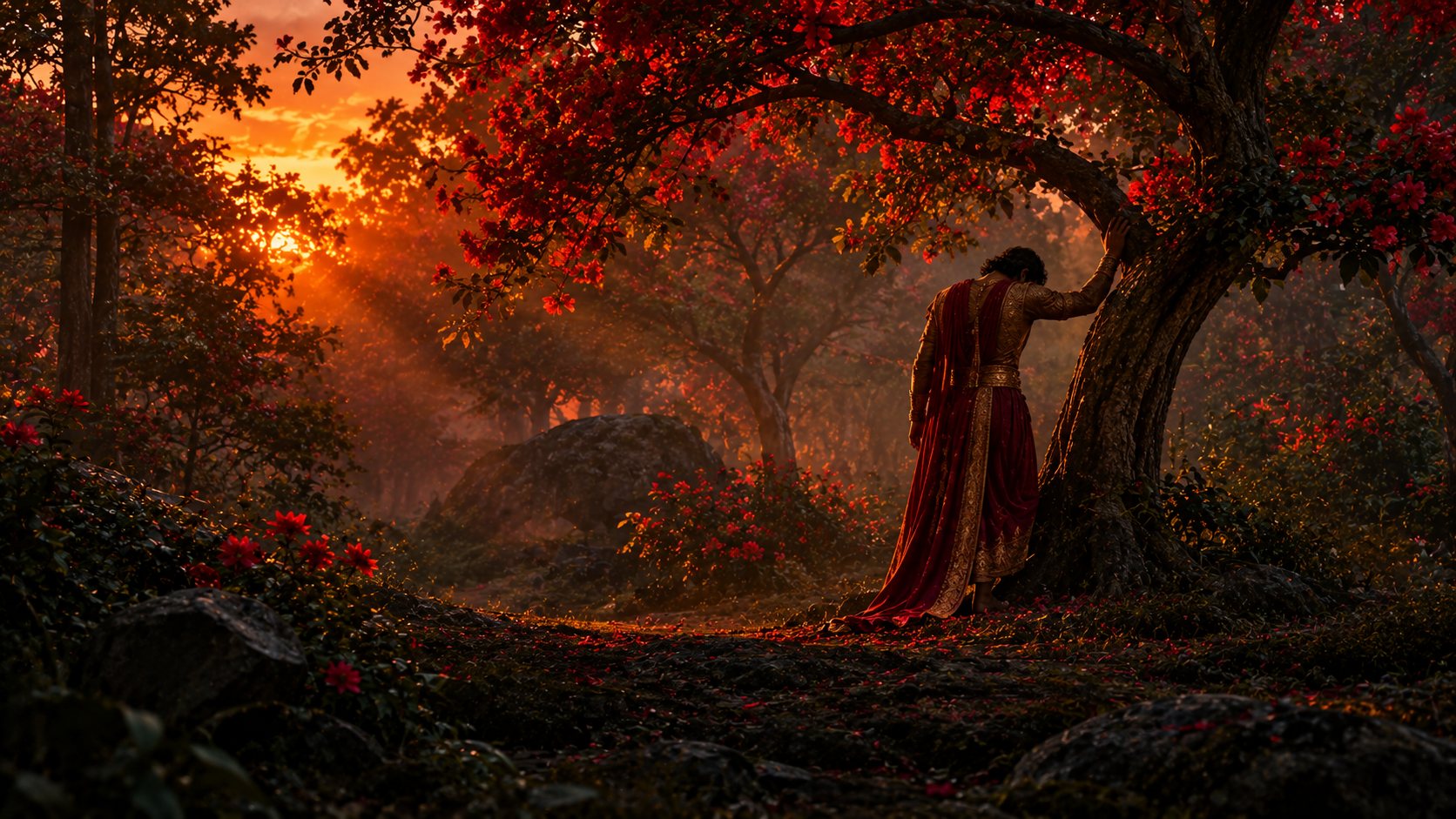
Iron is the possessive shade. It is the one people are most uneasy about, and the one that sells the most books, and both of those things are worth being honest about.
So here is the thing I want on the record. A man who cannot let go, who is not reasonable about it, who asks the whole world where she went, is not a modern invention and he is not a guilty pleasure. He is in a play by the poet, in the classical canon, taught in universities, and nobody has ever apologised for him.
Bhavana B
What happens in the play
The play is Vikramorvashiyam. Urvashi is an apsara, a woman of heaven. She is on her way back to heaven from Kubera's palace on Mount Kailasa when the demon Keshin seizes her and her companion Chitralekha. The nymphs cry out, and King Pururava rescues them.
They fall in love at first sight. Then she is summoned back to heaven, and he is left on earth unable to think about anything else.
What follows is almost comic in how human it is. He talks about her constantly to his friend. His queen Aushinari becomes suspicious when he calls her by Urvashi's name. Urvashi writes him a message on a birch leaf, and the wind carries it to the queen's feet. The queen is furious, and then declares she will not stand in the way of the lovers.
Before the two can meet, Urvashi is called to perform in a play, and at the critical moment she misses her cue and says Pururava's name instead of the name she was supposed to say. For that she is banished from heaven. Indra softens the sentence: she will stay on earth until her human lover sees the child she will bear him.
Then a series of mishaps separates them, and she is turned, for a time, into a vine.
In the end the curse is lifted and the lovers are allowed to stay together on earth for as long as Pururava lives.
The fourth act
The fourth act is why anyone remembers this play.
She is gone, and the king goes looking for her, and what he does is not search in any ordinary sense. Britannica calls it a mad scene. He wanders through a lovely forest addressing the various flowers and the trees as though each one of them were his love.
Think about the nerve of writing that. This is a king. This is the hero. And the finest poet in the language puts him in a forest talking to plants, and does not step in to make him dignified, and does not have another character tell him to pull himself together. The act simply lets him be that far gone.
That is Iron. Not cruelty, and not control for its own sake. A hold on someone that has stopped being reasonable, written without apology, in the canon.
Things this page will not pretend about
- The mad scene is described here, not quoted. The account of the fourth act comes from a reference work. This page quotes no Sanskrit from the play, because none was verified.
- A play is not an endorsement. The poet wrote a man undone by wanting someone. He did not write a manual, and this page is not saying that possessiveness is admirable. It is saying the feeling is old, serious, and has been taken seriously by better writers than me.
- The songs are not from the play. They came first.
The songs
One song on this shade is the fourth act in Telugu. He is not threatening anybody. He is just not going to stop, and the obstacles he lists get steadily more absurd, and that is exactly the register of a man addressing trees. Five more are in English, and three after those are in Telugu and Hindi. All of them are the same man on the same evening, saying it to the room instead of to her.
It opens by admitting he does not know whether everyone gets this. Then it tells you what he will do if he does.
| Nijamaina prema okkasari dorikite | If real love is found even once |
| Neneem chestano naaku telusu | I know exactly what I will do |
| Prema dorikite vadulukonu | If I find love, I will not let go |
| Praanam poyinaa venudiraganu | Even if my life goes, I will not step back |
| Lokame edurai nilichinaa | Even if the whole world stands against me |
| Naa prema kosam poraadutanu | I will fight for my love |
| Dooram mammalni vidadisinaa | Even if distance separates us |
| Daarulannee moosukupoyinaa | even if every road closes |
| Chivari shvaasa migilee varakuu | until the last breath is left |
| Tanani chere daari vetukutanu | I will keep looking for the road to her |
| Aakaashame adduga niliste | If the sky itself stands in my way |
| Aakaashanne nelaku dinchutanu | I will bring the sky down to the ground |
| Kaalam tanani naa nunchi daachite | If time hides her from me |
| Kaalanne daati vetukutanu | I will cross time and go looking |
| Dabbuto enno konagalanu emo | With money I could buy a great many things |
| Premanu maatram konalenu | but love is the one thing I cannot buy |
| Odipovadam naaku telisinaa | I know how to lose |
| Vadileyadam maatram nerchukonu | letting go is the one thing I will not learn |
Why it belongs here
The king in the fourth act argues with flowers. The man in this song argues with the sky and with time. Both are doing the same thing, which is refusing the terms of reality out loud.
And notice what the song does not say. There is nothing here about keeping her, owning her, or preventing her. Every line is about what he will do, what he will cross, what he will not learn. The whole force of it points at himself.
That is the difference between a possessive hero worth reading and one who is just frightening. The poet knew it too. His king does not go after anyone. He goes to pieces in a forest.
He watches her dance with someone else from a corner, certain, and does not move. No forest, but the same man.
| Hand on your waist and he thinks he is winning | |
| I have heard the real one That is not it | |
| Keep it up keep it up I like the show | |
| Dance a little closer let the whole room know | |
| I am in the corner with the best seat in the house | |
| Twenty seconds Still not looking | |
| Fifteen Still not worried | |
| Five She just turned her head | |
| Every time | |
The same stillness
The king in the fourth act does not chase Urvashi through the forest. He stands still and speaks to the trees. This song does the same thing in a ballroom. He does not cross the floor. He counts seconds in a corner and calls it winning.
The jealousy here burns in him, not at anyone. There is a Telugu version of this song further down, under its own title.
| His hand on your back yeah I saw that | |
| My heart skipped one beat that is a fact | |
| Smile all you want smile all you want | |
| But those eyes still come looking for me | |
| Burning burning but I play it cool | |
| This game is mine baby I wrote the rules | |
| A Donovan does not chase | |
| He waits And you always look back | |
A man speaking to himself
He never once tells her to stop smiling at the other man. He narrates his own burning and calls it a game he wrote the rules to. That is the fourth act's trick exactly, a man managing his own fire out loud instead of managing her.
The calmest song in this set. He hands her to another man for the length of one song, certain of exactly how long that lasts.
| Hey man She is all yours For now | |
| Enjoy it brother Take your time | |
| Enjoy it brother That song is three minutes | |
| Hold the waist do not hold too tight | |
| Spin her gentle keep it polite | |
| And when the lights come up let her go | |
| Cause she will be walking somewhere you do not know | |
Devotion without interference
He does not cut in. He does not glare. He hands her over for three minutes and knows, the way the play knows about its king, that none of this changes where she ends the night. Possession here is a private certainty, not an action taken on another person.
He holds her coat while she dances with someone else and counts songs instead of chasing her across the floor.
| Go on sweetheart Dance I have got your coat I have got all night | |
| Dance with him dance with him | |
| I will be right here holding your coat | |
| Laugh with him let him try | |
| Last dance is mine last dance is mine | |
| I do not push I do not shove I do not chase | |
| I have never once had to run for my place | |
The coat, not the hand
He is holding an object she will need later, not holding on to her. That is the whole posture of a man who cannot let go and has decided the letting go is hers to do, on a schedule he has already worked out in his head.
The one that says the thesis out loud.
| Said you do not remember That is cute | |
| Your hands say different in that dress That is proof | |
| Lie all you want lie all you want | |
| Your eyes keep coming home to me | |
| For one second there I was not in the frame | |
| Crowd between us nobody said my name | |
| Then you turned around found me first | |
| I do not chase | |
| I wait And you always look back | |
I do not chase I wait
The English songs in this set all end on a version of this same line. He never moves toward her. He stands in one place, certain, and waits for the room to turn. A king talking to a flowering branch is doing the exact same thing, just slower and in Sanskrit.
The Telugu twin of the song above. Same man, same evening, half the lines in another language. The Telugu is given here with the English of those lines beside it.
| Smile, smile, smile all you want | |
| Smile, smile, nanne chustaav | Smile, smile, you will still look at me |
| Naa gunde okka beat miss ayyingi, that's a fact | My heart missed one beat, that is a fact |
| Who gave him the right? Who gave him the right? | |
| Nee mungurulu sarde pani naadi, alright? | Fixing those curls of yours is my job, alright? |
| Nee kallu maathram nanne vetukutunnaay | Your eyes, though, keep searching for me |
| Burning, burning, but I play it cool | |
| Enta dooram vellina, you always return | However far you go, you always return |
He asks the room, never her
Every accusation in this song is aimed at the air. Who gave him the right is a question with nobody to answer it, asked by a man standing ten feet away who will not cross the floor. The king in the fourth act does the same thing to a row of trees. Neither of them is talking to the person they mean.
The quietest of the three, and the closest to the fourth act. He is not angry. He is taking an inventory of what was handed to somebody else.
| Aa navvu vaadikaa | That smile, for him |
| Aa choopu vaadikaa | That look, for him |
| Nenu daachukonna andamaina aa siggu kooda vaadikaa | Even that lovely shyness I had kept for myself, for him |
| Nenu asuyapadutunnanaa. Lede. | Am I jealous? No. |
| Naaku nacchanidi, vaadu neeku nacchinattundatam | What I do not like is that he seemed to please you |
| Ninnu kolpotanane bhayam kaadu | It is not the fear of losing you |
| Nuvvu inkokarito intha suluvuga navvagalavani nenu oohinchaledu | I had not imagined you could laugh that easily with somebody else |
| Ippudu cheppu, nenu em anukovali | Now tell me, what am I supposed to think |
A man arguing with himself
He asks whether he is jealous and answers his own question, which is how you know he is. Then he keeps listing. The smile, the look, the shyness, the moment. It is a man going through a scene item by item the way the king goes through the forest flower by flower, and getting no reply from any of it.
The Hindi one, and the only song in the set that admits it cannot name what it is feeling.
| Kuch nahi bola main chup raha | I said nothing, I stayed quiet |
| Par andar kuch jalne laga | But something started burning inside |
| Yeh jung nahi, yeh pyaar nahi | This is not war, this is not love |
| Yeh jo hai, iska naam nahi | Whatever this is, it has no name |
| Woh tujhe dekh raha tha jis tarah, woh nazar meri honi chahiye thi | The way he was looking at you, that look should have been mine |
| Main woh hoon jo jhukta nahi | I am the one who does not bend |
| Toh yeh bechain kyun hoon main aaj | Then why am I this restless today |
| Main nahi dikhaunga, main nahi bolunga | I will not show it, I will not say it |
A feeling with no name
This is the most honest song of the set, because it stops trying to be clever. He does not know what the feeling is, only that it is there and that he will not let it be seen. The fourth act is the same admission written long: a man who cannot say the thing to anyone who could answer, so he says it to the forest instead.
A last word
People who are nervous about this kind of hero are usually nervous about control. That is a fair thing to be nervous about, and it is worth saying plainly that a man who takes a woman's choices away is not a romance, he is a warning.
But the man in the fourth act takes nothing from anybody. He has simply been reduced, by wanting someone, to a person standing in a wood talking to a tree. The poet looked at that and decided it was worth an act of a play.
I am not going to be shy about a shade called Iron when that is the company it keeps.
Where this page gets its facts
The plot of the play, Urvashi and Chitralekha, the demon Keshin, Pururava's rescue, the queen Aushinari, the message on the birch leaf, the missed cue and the banishment, Indra's modification of the sentence, the transformation into a vine and the ending come from the Wikipedia article on Vikramorvashiyam. The description of the fourth act as a mad scene in which the king wanders through a forest addressing the flowers and trees as though they were his love comes from Britannica's article on the play. No Sanskrit is quoted, because none was verified.