There are two character playlists on this site. His Half, which is what Jimmy sounds like when nobody is watching. Her Half, which is what Sofie never says.
I called them halves because it sounded right. Then I went looking, and found that the tradition I grew up in had already made the same decision about the same two people, in a statue and in a verse, and had been a good deal more precise about it than I was.
Bhavana B
The statue
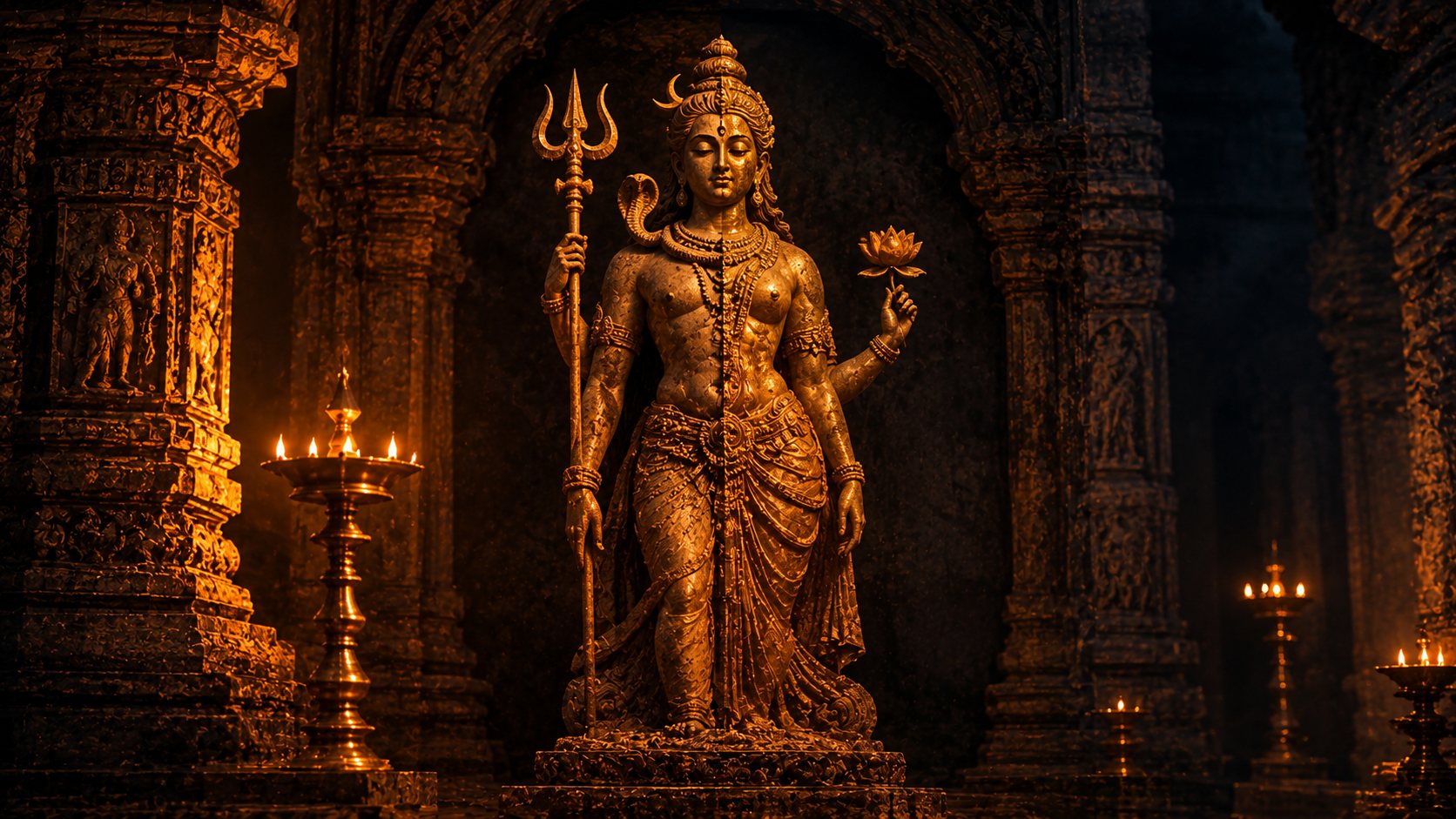
There is a form of Shiva called Ardhanarishvara. Britannica describes it as a composite male and female figure of the god Shiva together with his consort Parvati.
It is one body, divided down the middle. The right half carries the traditional ornaments of Shiva. The left half is marked by feminine features, such as hair well combed and knotted. One figure, two sides, and the line runs straight down the centre of it.
What it means, according to most authorities, is that the male and female principles are inseparable.
Not complementary. Not well matched. Inseparable, which is a much stronger word, and means you cannot have one of them on its own.
The verse
Mahakavi Kalidasa opens his Raghuvamsham, the long poem on the dynasty of Rama, with a prayer to the same pair. It is one of the best known verses in Sanskrit, and it is quoted at weddings, at the start of books, and by people who have never read the poem.
Mahakavi Kalidasa wrote Raghuvamsham, verse 1
वागर्थाविव सम्पृक्तौ वागर्थप्रतिपत्तये ।
जगतः पितरौ वन्दे पार्वतीपरमेश्वरौ ।।
vāgarthāviva sampṛktau vāgarthapratipattaye
jagataḥ pitarau vande pārvatīparameśvarau
I bow to Parvati and Parameshvara, the parents of the world, who are joined inseparably as a word and its meaning are joined, so that I may grasp words and their meanings rightly.
| vāgarthau | word and meaning |
| iva | like, as |
| sampṛktau | inseparably joined |
| vāgarthapratipattaye | for the understanding of words and their meanings |
| jagataḥ | of the world |
| pitarau | parents |
| vande | I bow to |
| pārvatīparameśvarau | Parvati and Parameshvara |
Look at the image he chose. He is a poet, and he is about to write a very long poem, so he asks for the thing he needs: the right grasp of words and their meanings. And to describe a marriage he reaches for the one pair that proves his point. A word without its meaning is a noise. A meaning without a word cannot be said. Neither of them is a half that could manage on its own.
Things this page will not pretend about
- There is a second reading of the verse. If the final compound is split differently, it can be read as a prayer to Shiva and to Vishnu rather than to Parvati and Shiva. The reading given here is the usual one, and the other one exists.
- Jimmy and Sofie are not the gods. As everywhere else on this site. The verse is here because it is the best description of two halves ever written, not because anyone in my books is divine.
The two songs
One from each shade. Neither was written with this verse anywhere near it, and both of them land on the same word.
She sang and stopped. He has the tune and not the end of it, and he has been trying to finish it alone ever since.
| Nuvvu paadi vadilina paata entha theeyaga migilindi | The song you sang and left behind, how sweetly it remains |
| Naa gonthulo aagina swaram entha maunamga ragilindi | The note that stopped in my throat, how silently it burns |
| Thegina veena theegalona entha madhuramaina baadha | In a broken veena string, what a sweet pain |
| You left the melody hanging in the air | |
| But the last line only lives in your tone | |
| I'm just half a song without you | |
| A tune that never finds its end | |
| Sagam raasina lekha laaga entha andamainadi mana katha | Like a half written letter, how beautiful our story is |
| Mugimpu leni paata laaga entha ninduga undi ee vyatha | Like a song with no ending, how full this ache is |
| Half a letter half a rhyme | |
| Half a heart still keeping time | |
| Nuvvu leka nenu eppatiki sagam paatane | Without you I am forever only half a song |
| Nee pedavi thaakithene poorthavuthunna | Only when your lips touch it is it finished |
The same claim as the verse
A word without its meaning is a noise. A song without its last line is a tune. The verse and the song are making the identical argument with different instruments.
And the last line settles which half he is. He is not the song. He is the half of it that cannot finish itself.
A long unmetred piece, almost spoken. Everything in it is a before and an after, and the turn comes when she steps away.
| Jaise mere dil ke kamre mein saalon se band ek khidki achanak khul gayi ho | As if a window shut for years in the room of my heart had suddenly opened |
| Aur hawa ka pehla jhonka mere seene ko chhoo kar keh raha ho ki main ab zinda hoon | and the first gust of air touched my chest and told me I am alive now |
| Jaise meri dhadkan tumhari aankhon ke raaste mere seene se nikal kar tumhari saanson mein ghul gayi ho | as if my heartbeat had left my chest by way of your eyes and dissolved into your breathing |
| Aur jab tum thodi si door gayi | And when you went a little away |
| toh laga jaise mere andar ki saari roshni dheere dheere kam hone lagi ho | it was as if all the light inside me began slowly to go down |
| Ki tum bina main sirf aadha hoon | That without you I am only half |
| sirf khaali hoon sirf ghum hoon | only empty, only lost |
| Aur phir jab tum wapas aayi toh laga jaise mere saare tute hue pal ek hi baar mein jud gaye ho | And then when you came back it was as if every broken moment in me joined together at once |
Only half
Tum bina main sirf aadha hoon. Without you I am only half. She does not say incomplete and she does not say lonely. She says half, which is a measurement, and it is the same measurement the verse makes.
His song says he is half a song. Hers says she is half a person. Two playlists, two languages, one word, and a fifteen hundred year old verse sitting quietly underneath both of them saying yes, that is how this works.
These two songs are one side each of two full playlists on the soundtrack, His Half and Her Half, his side of the saga and her side of it, kept separate everywhere else on this site on purpose. Read side by side, or on their own.
Hear His Half → · Hear Her Half →
A last word
I named those two playlists in about four seconds, on a day when I was doing something else. The name was right for a reason I could not have told you at the time.
A word and its meaning. One body with a line down the middle. Half a song. Half a person. Everybody who has ever tried to describe this has reached for the same arithmetic, and the arithmetic is always the same: one, divided, and not able to stay divided.
Where this page gets its facts
The description of Ardhanarishvara as a composite male and female figure of Shiva with Parvati, the right and left halves, and the statement that most authorities read it as meaning the male and female principles are inseparable come from Britannica's article on Ardhanarishvara. The Sanskrit text of the opening verse of the Raghuvamsham, its transliteration, its translation, the word by word meanings and the note on the alternative reading of the final compound come from the Raghuvamsham verse page at shlokam.org.